

Wall-Mounted Heat Pump vs. Central HVAC System: Which Option Is Best for Your Home?
Quebec’s weather is anything but predictable. From humid July heat waves to freezing January mornings when temperatures drop below -20°C, your home is your sanctuary. Staying comfortable year-round isn’t a luxury—it’s a necessity.
If you’re planning a renovation or building a new home, you’ve probably encountered one of the most common HVAC dilemmas in Quebec: wall-mounted heat pump vs. central HVAC system. What’s the real difference? Does a two-storey home automatically require a central system? And what if your house doesn’t have existing ductwork?
Don’t worry—you don’t need to become an HVAC engineer to make the right decision. In this straightforward guide, we’ll compare both options based on your home’s layout, your comfort expectations, and your budget.
1. Wall-Mounted Heat Pumps: A Flexible and Cost-Effective Solution
Wall-mounted heat pumps (also known as ductless mini-split systems) have become the most popular heating and cooling solution in Quebec, especially for existing homes and condominiums.
How Does It Work?
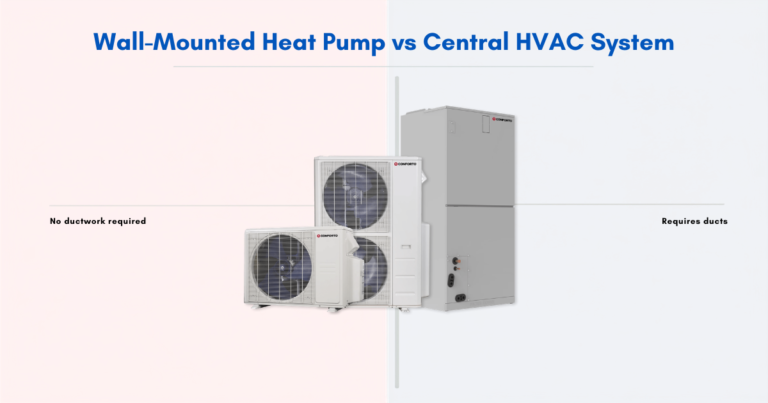
A wall-mounted heat pump consists of two main components: an outdoor compressor and one or more indoor wall-mounted units installed high on the wall. These indoor units provide cool air during the summer and efficient heating during the winter directly to the rooms where they are installed.
Best Suited For Homes Without Existing Ductwork
If your home is currently heated with electric baseboards or hot-water radiators, installing ductwork throughout the walls and ceilings can quickly become expensive and disruptive. A ductless heat pump can usually be installed within a few hours without major renovations.
Bungalows and Condominiums
Open-concept layouts are ideal for wall-mounted systems because conditioned air circulates naturally throughout the living space with minimal obstructions.
Multi-Zone Configurations
Own a two-storey home? No problem. Modern multi-zone (multi-split) systems allow two or three indoor units to connect to a single outdoor compressor, making it easy to cool the main living area downstairs while keeping bedrooms comfortable upstairs.
2. Central HVAC Systems: Maximum Comfort with an Invisible Design
Central HVAC systems are often considered the gold standard for whole-home comfort. If your goal is consistent temperatures throughout every room, this is the solution to consider.
How Does It Work?
A central heat pump works together with an indoor air handler (often integrated with an electric, gas, or oil furnace). Heated or cooled air is distributed throughout the home using a concealed network of air ducts, with air delivered through discreet floor or ceiling vents.
Best Suited For Homes with Existing Ductwork
If your home already has a functional duct system connected to an older furnace, you’ve already completed the most expensive part of the installation. Upgrading to a central heat pump is often a natural and highly cost-effective transition.
Large Multi-Storey or Complex Homes
Unlike a wall-mounted unit that conditions air from a single location, a central system delivers even airflow to every bedroom, office, hallway, and basement. Say goodbye to temperature differences between floors.
Homeowners Who Prefer a Clean Interior Design
With a central system, there are no visible indoor units mounted on your walls. Only discreet supply and return vents remain visible, preserving your home’s aesthetics.
3.Which Option Is Right for Your Home?
Ask yourself these three simple questions:
1.Does my home already have ductwork?
If the answer is yes, a central HVAC system is often the most practical choice. If not, a wall-mounted (single-zone or multi-zone) heat pump is typically the most economical and straightforward solution.
2. What is my home’s layout?
Open-concept homes perform exceptionally well with wall-mounted systems. However, older homes with many small enclosed rooms and long hallways are generally more difficult to cool evenly with a single indoor unit. In those cases, multiple indoor units—or a central system—may provide better comfort.
3. What is my overall budget?
If you’re looking for the best balance between performance and affordability without major renovation work, today’s wall-mounted heat pumps offer outstanding energy efficiency while significantly reducing Hydro-Québec electricity costs—often at a fraction of the installation cost of a complete central duct system.
It’s also worth remembering that the Quebec government offers attractive incentive programs, such as LogisVert, for high-efficiency heat pump installations, whether ductless or central. There’s never been a better time to invest in year-round comfort while lowering your energy consumption.
Need Expert Advice?
Every home has its own unique characteristics and structural challenges. That’s why nothing replaces a personalized in-home assessment.
At Xalie Climatisation, our certified technicians will evaluate your home’s layout, discuss your comfort goals, and recommend the heating and cooling solution that best fits your needs and budget.